Are Transition and Physical Climate Risks Priced? Evidence from Directional News-Based Measures
Clément Toussaint 
Abstract
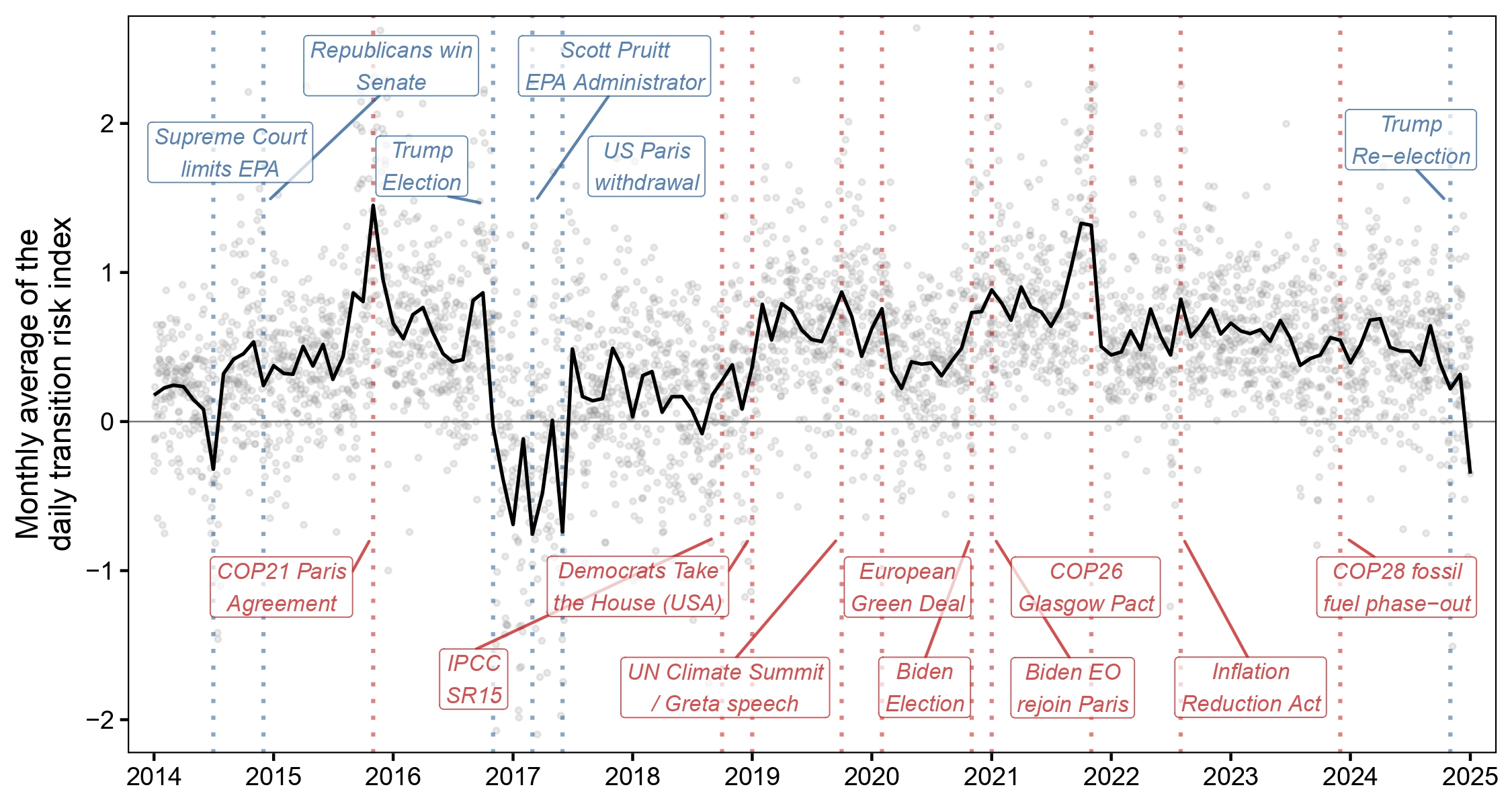
Climate news can signal rising or falling risk, yet existing news-based climate risk measures do not distinguish between the two. Using a large language model, I classify over 160,000 newspaper articles and build daily transition and physical climate risk indicators that capture the direction, intensity, and horizon of the risk each article conveys. Transition-risk shocks carry a significantly negative price of risk in the cross-section of U.S. stock returns, and higher transition risk predicts lower future market returns—the joint pattern implied by intertemporal hedging. Physical risk forecasts returns but is not priced, consistent with its localized nature. In horse-race tests, only the directional indicator is priced, and removing direction reverses the sign of the predictive relation, breaking the consistency between pricing and predictability. Direction is thus what turns climate news into a measure of transition risk: without it, media coverage captures attention, not risk.
Key Figure
Citation
@unpublished{toussaint2026climaterisk,
  title    = {Are Transition and Physical Climate Risks Priced? Evidence from Directional News-Based Measures},
  author   = {Toussaint, Clément},
  year     = {2026},
  note     = {SSRN Working Paper},
  url      = {https://ssrn.com/abstract=6431199}
}