Monetary Policy Surprises and Stock Returns Across Climate Transition Risk Regimes

Work in Progress
Transition Risk
Monetary Policy Surprises
Regime Dependence
Author
Affiliation

Clément Toussaint

Université Paris 1 Panthéon-Sorbonne, CNRS, Centre d’Économie de la Sorbonne

Published

September 1, 2026

Abstract

Do monetary policy surprises affect the winners and losers of the climate transition differently? The evidence is mixed, and existing explanations – capital tangibility, duration, investor preferences for green assets – all predict a stable differential. Exploiting a decade of large swings in transition risk in the United States, including deregulation episodes, I estimate, rather than impose, high and low transition risk regimes. The brown–green differential in the response of stock returns to monetary policy surprises exists only when transition risk is high; under expected deregulation it does not weaken, it disappears. A time-invariant channel cannot switch off with the policy environment; a state-dependent carbon premium can. Whether monetary policy transmits differently to green and brown firms thus depends on the climate policy regime.

Key Figure
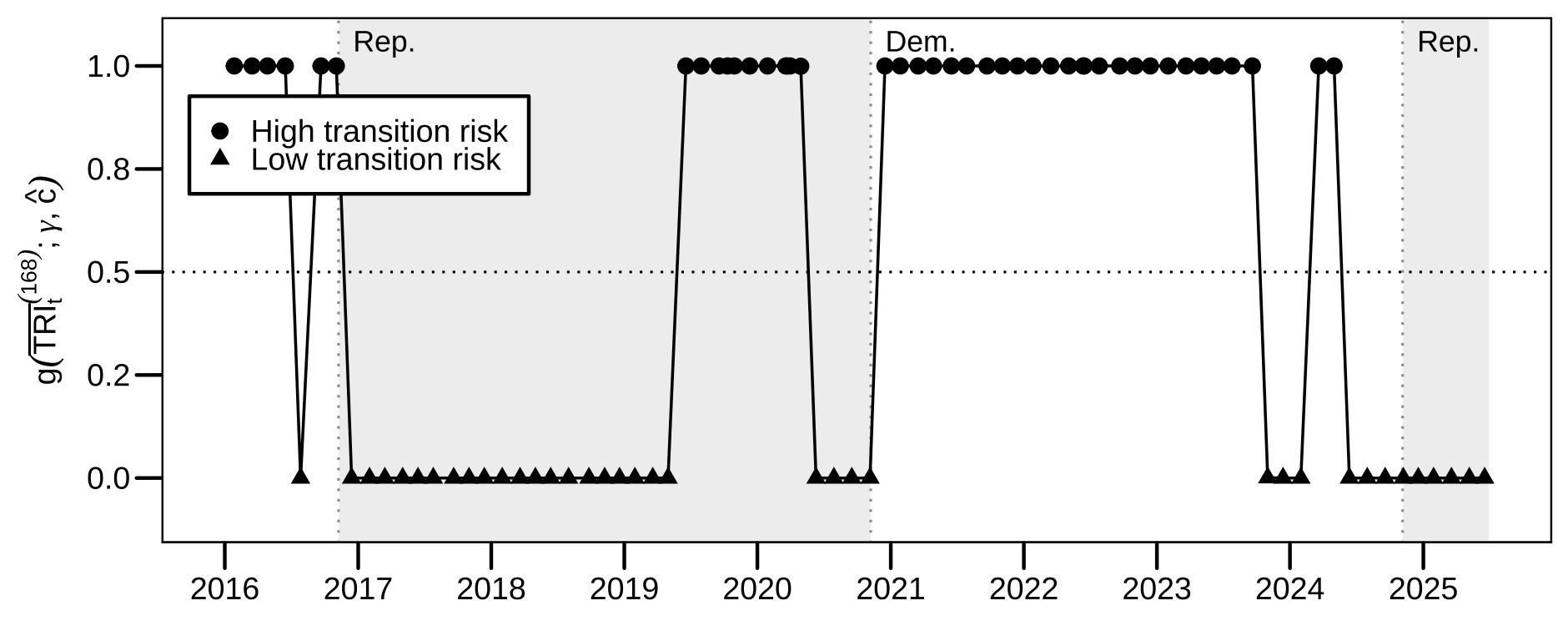
Figure 1: Climate transition risk regimes at FOMC announcements, 2016–2025. Each marker is a scheduled Fed monetary policy announcement, classified as occurring in a high (●) or low (▲) transition risk regime. Regimes are estimated with a panel smooth transition regression (PSTR) model, using a moving average of the Transition Risk Indicator as a transition variable. Shaded areas mark Trump presidencies. Regimes are persistent but do not simply follow the political cycle: the high-risk regime starts in mid-2019, well before the 2020 election, and fades during 2024, before the November vote.

Figure 1: Climate transition risk regimes at FOMC announcements, 2016–2025. Each marker is a scheduled Fed monetary policy announcement, classified as occurring in a high (●) or low (▲) transition risk regime. Regimes are estimated with a panel smooth transition regression (PSTR) model, using a moving average of the Transition Risk Indicator as a transition variable. Shaded areas mark Trump presidencies. Regimes are persistent but do not simply follow the political cycle: the high-risk regime starts in mid-2019, well before the 2020 election, and fades during 2024, before the November vote.